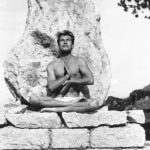
If we really didn’t understand Dharma, we would have titled —saying it wrong—,”Sat Adharma Dharma”, it means, “The Doctrine of the Non-Doctrine of BEING”.
But understanding Dharma with all embodied possibility, we have titled this work of Proclamation as “Sat Dharma”.
Understanding Sat Dharma, any other title might be appropriate for him.
Advaitananda Vyasa Goe
Just as magma —by its own mechanism of internal pressure— finds the right ways to erupt and come out on the surface of the Earth, LIFE manages to emerge —by intimate dynamics of Itself—, into those attentive and sincere hearts that—turned into mere channels of manifestation—, give voice to the appropriate presentation at each age.
This is how it has been and always will be, here and there, in East or West, in this world or in any other imaginable. Because, ultimately, if introspection is sincere, one cannot be talking about anything other than LIFE.
Sat Dharma is the Proclamation of the Non-Dual Nature of LIFE (Advaita Samnidhi), realized and shared by Sri Bhagavan Advaitananda Vyasa Goe1.
It points out the Nature proper to LIFE in the most bared and direct way possible: What Is, Is (Sat), and consequently, there is no more Law that LIFE itself (Dharma).
In other words, LIFE, as Totality, is ONE and operates as such.
We are LIFE
As an immediate natural consequence, it follows that LIFE —What Is—, shapes us and gives us existence: nothing has its own differentiated existence outside of LIFE. If we are, if we exist, it is because we are LIFE, forms of LIFE.
To live in harmony and fullness we just have to realize that, beyond the feeling of individuality, our true nature is none other than the very Nature of LIFE, from which we are inseparable.
Therefore, every being has in itself, naturally, the faculty of realizing LIFE. They have the possibility of direct experience at their fingertips. More. Beyond experience: BEING LIFE.
And when we are something, whatever it is, you don’t have to believe in it anymore. There is no longer a need. We have it incorporated.
Sat Dharma invites us to stop believing in explanations and fantasies —no matter how well structured they are—, and to discover, by and in ourselves, what we are.
The transcendence of LIFE is HERE (on the understanding that we are not talking about a spatial coordinate, but about the absolute dimension of LIFE), and not in distant celestial worlds or ultramundane divine dimensions.
VIDA operates without the need for doctrines or codes about what is right or wrong. It does not establish a distinction between what is sacred and what is profane. He does not understand about rewards or punishments, sins, guilt or negative karma. It simply IS.
The harmony of living will not be found in elaborate codes of conduct, but simply in the adaptation to the very operation of VIDA.
The duality confusion
Sat Dharma points to the dual gaze as the root of all the conflicts, hopes and fears that overwhelms us. A dual gaze nourished for the clinging to the feeling of individuality that eclipses our intimate nature.
We live with the attitude, the feeling of “going through life”, that we come from we don’t know where, and we don’t know where we are going to end up. We believe we have our own existence differentiated from LIFE, which is something alien to us, an uncertain space-time that we travel limiting ourselves to chasing pleasant sensations, fleeing from unpleasant and anguished ones at all times —consciously or unconsciously—, for fear of ceasing to be, of ceasing to exist.
This dual gaze – and the consequent vital anguish – are nourished by the joint action of what we perceive and call as “our” constituents: body, sensations, perceptions, mental formations and consciousness.
It is not difficult to observe how each of them operates in a binary (dual) way when interacting with what we call reality and how the fragmented vision with which we live begins: my body and others; I like this feeling and this one I don’t; I desire what I like and reject what I don’t; this is good and this is bad; that’s right and that’s wrong…
We end up identifying ourselves as a subject surrounded by an infinity of objects that we describe and identify through language. A language that is also dual, which reaffirms the illusion that the name makes the thing and makes us interpret the paradoxes of LIFE as dichotomies between pairs of completely antagonistic opposites: good/evil, life/death, masculine/feminine, spirit/matter, man/god…
A sincere introspection
Clearing up the double confusion is simple: VIDA and I are not two. But simple is not synonymous with easy because, simply, a merely intellectual understanding will not be enough. We need an effective, transmuting realization, incorporated into the depths of ourselves.
Certainly, direct realization is instantaneous. We just have to realize. But it is also true that clearly vision can be considered the result of a progressive discovery and detachment from everything that feeds dual confusion. Sat Dharma does not differentiate one from the other.
A minimum intuition will be enough to address the paradox of the apparent contradiction between unity and multiplicity that we perceive with the senses: LIFE is not static, it is a dynamic Whole in constant transformation, generated by the continuous action of polarity in Itself.
Polarity is not two antagonistic opposite extremes, but two poles that cannot be understood without each other. We wouldn’t hear the sound without the silence. There is no light without darkness. There is no masculine without feminine. There is no day without night. There is no what we call life without what we call death. The dynamic balance between both poles is what generates diversity. Between white —the sum of all colours—, and black —the absence of all of them—, lies the infinite chromatic range. Unity and Multiplicity are not two things. LIFE creates itself at every moment.
It is precisely to highlight this dynamic unity of LIFE, that speaking in terms of Non-Duality (Advaita), shows more intuitively that unity is not uniqueness or uniformity, but that it incorporates the polarity that generates all possible diversity. Understanding what we are talking about when we talk about LIFE, unity and non-duality will be indistinct synonyms.
If the desire to see clearly is sincere, it will not take long for us to intuit that we will not find the answers we are looking for “outside” and we will begin to look “inside”, wondering if confusion could not be in our way of looking.
It will be then that a sincere introspection will allow us to discover how the constituents that make us up operate. To the extent that each constituent ceases to go freely, puts itself in its place and operates harmoniously with each other, the agitation of the waters will calm down and allow us to see the bottom. So we will be able to realize that there is no “inside” and “outside”. Only LIFE.
And at all times we will have done nothing but live. Living naturally. Living every moment by the more appropriate way, with LIFE as the only reference (while we need it). Without forcing, judgments or guilt. Without excluding anything. Nothing left over. Nothing is missing.
A single Tradition
Sat Dharma is not another canon, belief, religion, or philosophy. It has no claim to explain LIFE. It does not give miraculous recipes, nor does it offer comfort or refuge. It does not propose any ethical or moral code.
Nobody should to tell to human beings how they should live, what they should feel or how they should behave. When we realize Non-Dual Presence of LIFE —that is, when we realize what our intimate nature is—, all vital restlessness disappears; no answers are needed, because the questions cease to make sense; doubts, generated by beliefs, and the need for intellectual explanations, give way to direct experience. What better guide than the one dictated to us by the Heart, which we will call ours, but which is none other than the One Heart of LIFE.
It will be said that Sat Dharma cannot be attributed any originality. Great beings of all times —some well known, others totally anonymous, but equally blessed—, after a sincere dedication, an intimate inquiry and by their own experience, have also pointed out the Unity of LIFE, adding that the realization of the Non-Dual Nature of Life leads the human being to the natural fullness that corresponds to him.
The novelty may not be found in the what, but perhaps in the how.
Sat Dharma transcends the differentiation between the various forms of Tradition, by pointing to LIFE as the only Tradition that has been presented and adapted by the respective Proclaimers to the idiosyncrasies of each time and culture.
Their legacy of wisdom is a collective heritage for every human being, beyond geographical, mental or cultural borders, with which we identify by the simple fact of having been born in one place or another. A heritage that, of course, also incorporates the wisdom of those views from philosophical, scientific or even ideological aspects, which favor the human being with a clear vision of the Primordial Nature of LIFE.
It should not be interpreted, therefore, by the use of terms of this or that form of Tradition, that Sat Dharma is circumscribed to one or the other. As it considers them common heritage, it freely uses those terms that best evoke what is intended to be indicated. Certainly, the term Advaita (not two), is distinctly Indian and points out better than any other the Non-Duality of LIFE. However, Sat Dharma speaks of Universal Advaita, because the Advaita voice, that is, the signaling of the Unity of LIFE, is not circumscribed exclusively to the Indian world.
In the same way, consistent with the vision of a single Tradition and with the full acceptance of the intimate situation of every human being, whatever it may be, Sat Dharma cannot demand exclusivity or the abandonment of the form of Tradition that each one considers as own, either by cultural roots or by personal choice. On the contrary, it encourages us to sincerely delve into the path of discovery of the wisdom that each one of them treasure, with the certainty that, as dogmatic beliefs give way to transformative intimate experiences, it will be found that all the branches spring from the common trunk of the Unity of LIFE.
So It doesn’t matter the way. At no time do we stop being LIFE, even if we are not fully aware of it. If the longing is sincere and the dedication constant, the access to clear vision will be natural and inevitable.
Adjust gaze
Sat Dharma involves a new gaze based on the intimate experience of knowing that we are one with LIFE. A new gaze that is more natural, logical and consistent with the operability of VIDA that transmutes individual and, by extension, collective feelings.
The simple intuition of Non-Dual Nature of LIFE shows the human being the mistakes of the past and the peremptory need to change the gaze to adapt to the new times, present and future. It is not a question of changing some beliefs for others, but of committing to building ourselves effectively and harmoniously in order to find the worthy place that corresponds to us in LIFE.
The human being must shake off the disastrous feeling of inferiority before superior or divine entities, but at the same time also the pernicious pride and arrogance of feeling himself the measure of all things, the apex of evolution, the universal king who can dispose of everything around him as he pleases, without considering the repercussions for the rest of sentient beings, the planet or the Universe. Only in this way will we be able to recognize the dignity and responsibility that corresponds to us as Agents of LIFE, as operational fingers of own LIFE.
If we dispel the dual confusion and stop clinging to the crude egoic instincts, we will be able to realize that beyond a fraternity of individuals, humans share —we are—, the same nature. Therefore, each and every one of us resents the joys and sufferings of each other. It is necessary to abandon indoctrination and subjugation, and to promote the lucidity and fullness of men and women for themselves. No intermediaries. Respecting the intimate situation of each one. Without forcing or imposing.
On each one depends —and only on each one— the determination to begin the dedication to an exciting construction of oneself that will ultimately lead to the natural and consequent joy of living.
Universal consciousness
is the repeated sum
of all forms of consciousness.That is why the shape you give it
Advaitananda Vyasa Goe
is important.
- Advaitananda did not leave the Proclamation in writing. Just a few notes. Surely because, as he said, language cannot describe what is ineffable and also because it is not appropriate to leave fixed a text that can be interpreted conceptually as a canon to be followed to the letter.
He encouraged, however, that each one express their particular bhashya, the particular vision resulting from their own experience, so that a collective view of the Primordial Nature of LIFE is articulated.
So this particular contribution of four brushstrokes should be understood, not as an exhaustive definition of Sat Dharma, but only as an insinuation of the purpose and the appropriate approach to undertake the dedication of each one towards a clear vision. ↩︎